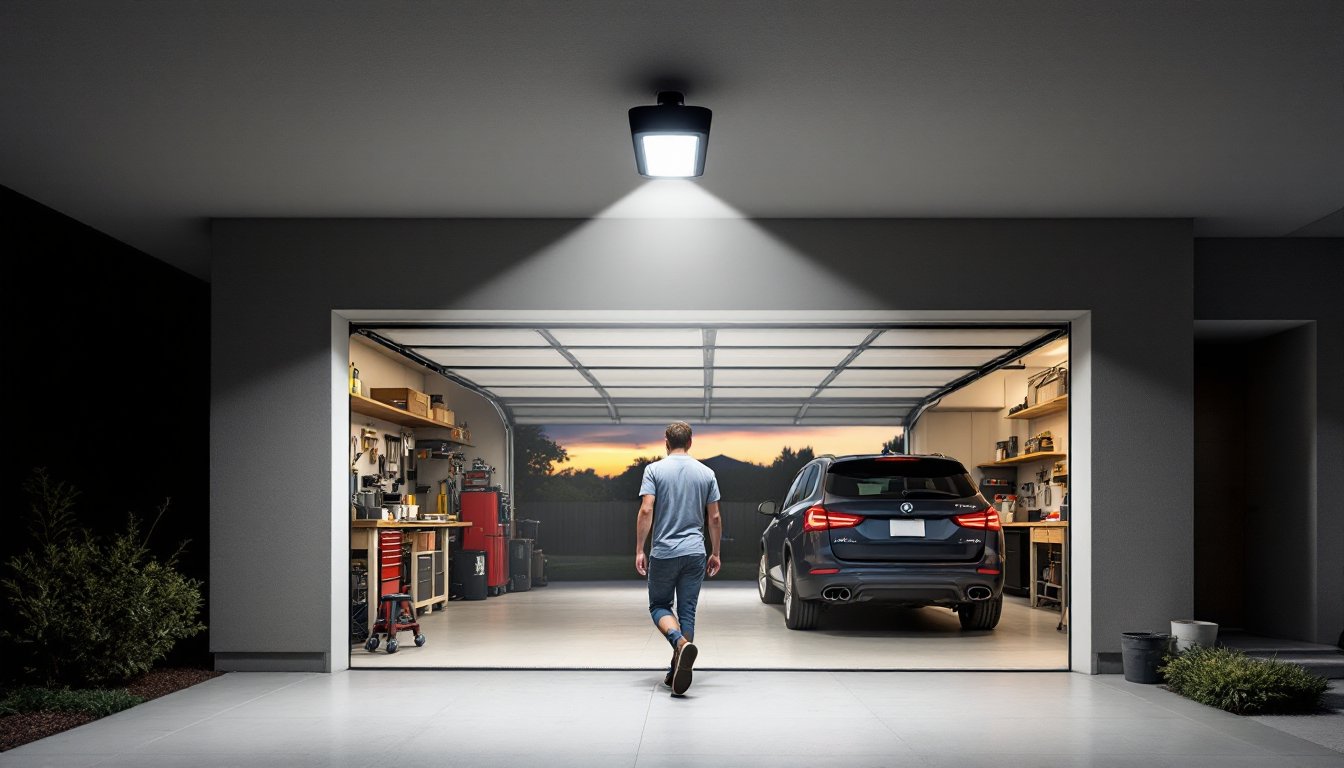
Garage lighting doesn’t get much attention until you’re fumbling around in the dark or realize your hands are full and you can’t flip a switch. Motion sensor garage lights solve that problem elegantly, they turn on automatically when you pull in, walk past, or step into the space. Beyond the convenience factor, they cut energy waste, improve security, and take the guesswork out of lighting coverage. Whether you’re upgrading an older garage or building new, motion sensors have become affordable and practical enough that skipping them feels like an oversight. Let’s walk through what they are, why they matter, and how to pick the right one for your setup.
Table of Contents
ToggleKey Takeaways
- Motion sensor garage lights automatically turn on when movement is detected and off after a set delay, eliminating the need to manually flip switches and providing immediate illumination when your hands are full.
- A motion sensor garage light can reduce energy consumption by 70–80% compared to continuously running lights, with LED fixtures paying for themselves within 1–2 years through lower electric bills and fewer bulb replacements.
- Passive infrared (PIR) sensors are the most reliable and affordable option for residential garages, offering better resistance to false triggers than microwave sensors while covering typical 20–40 foot detection ranges.
- Proper brightness requires 3,000–5,000 lumens for a two-car garage, achievable with two single LED floodlights or one dual-head fixture, prioritizing lumen output over wattage when comparing brightness levels.
- Hardwired installation provides the safest and most permanent solution for motion sensor garage lights, though wireless and plug-in options offer quicker alternatives for renters or temporary setups.
- Motion sensor lights enhance home security by illuminating approach zones and deterring casual intruders while improving convenience and safety by reducing trip hazards in dark garage areas.
What Are Motion Sensor Garage Lights?
Motion sensor garage lights are fixtures equipped with an infrared or microwave sensor that detects movement within a defined zone and triggers the light on. The sensor typically turns the light off automatically after a set delay (usually 5–30 minutes, depending on the model) if no additional motion is detected.
These aren’t smart bulbs you swap into an existing fixture, though that’s an option. Most garage motion sensor lights are self-contained units that you mount on a ceiling, wall, or soffit. They come in several styles: LED floodlights (bright, wide beam coverage for general illumination), track lights (adjustable fixtures for targeted light), and integrated fixture styles that replace standard ceiling lights.
The sensor operates on simple physics: it detects heat signatures from moving objects (your car, you walking) and triggers a relay inside the fixture. There’s no app to unlock, no smart home hub required, and no batteries to fret over (hardwired units plug into standard circuits). Some premium models offer WiFi control and scheduling, but the basic function works without any of that.
Key Benefits Of Installing Motion Sensor Lighting
Energy Efficiency And Cost Savings
The biggest win is energy savings. A typical garage light left running all day or night burns 150–300 watts per fixture, depending on the bulb type. Motion sensors cut that dramatically, lights only run when needed, which for most garages is a fraction of the day.
LED motion sensor fixtures use 25–40 watts compared to 60–100+ watts for older incandescent or halogen setups. Over a year, a single fixture can drop energy consumption by 70–80% if it was previously left on continuously. Recent smart home technology reviews highlight how motion sensors are among the quickest ROI upgrades for homeowners, often paying for themselves in reduced electric bills within 1–2 years.
Cost savings also include fewer bulb replacements. LED fixtures rated for 25,000–50,000 hours of use last 5–10 years in typical garage use, versus 1,000–2,000 hours for incandescent bulbs. That means fewer trips up a ladder and less money spent on replacements.
Enhanced Security And Convenience
Motion lights act as a basic perimeter deterrent. A suddenly illuminated garage discourages casual prowlers and makes it harder for someone to approach your home unnoticed. They’re not a security system replacement, but combined with cameras or alarms, they’re a practical layer of defense.
On the convenience side, never again fumble for a light switch with a full load of groceries or dark arms full of tools. Reliable expert-tested motion sensor lights for garages automatically illuminate as you approach, creating a safer entry and reducing trip hazards. You also avoid the annoying scenario of wandering into a dark corner only to realize the light switch is 20 feet away.
Choosing The Right Motion Sensor Garage Light
Sensor Type And Detection Range
Two main sensor technologies dominate the market: infrared (passive infrared, or PIR) and microwave. PIR sensors detect body heat and are most common in residential garages. They’re reliable, affordable, and work well indoors. Microwave sensors emit radio pulses and detect movement directly, they’re slightly more sensitive and can detect motion through light walls, but they’re pricier and can be oversensitive in high-traffic areas.
For most homeowners, PIR is the better choice. It’s less prone to false triggers from pets or HVAC drafts, and the technology is mature and proven.
Detection range matters. A typical garage motion light covers a 20–40 foot range and a 100–180-degree detection angle. If your garage is narrow (single-car width) and you’re mounting the sensor centrally, a 20-foot range works fine. Larger two-car or three-car garages benefit from fixtures with extended range, or multiple smaller fixtures positioned strategically.
Also check the delay settings. Adjustable dusk-to-dawn mode (light operates only after sunset) saves even more energy and is standard on quality units. A delay of 5–10 minutes suits most garages: longer delays (20–30 minutes) waste energy, and shorter delays (under 5 minutes) can feel jarring if you’re working in the space.
Brightness, Wattage, And Installation Options
Garage lighting brightness is measured in lumens. A typical two-car garage needs 3,000–5,000 lumens of total light output for safe working visibility. A single 60-watt-equivalent LED floodlight produces roughly 800–1,000 lumens, so you’ll likely want two fixtures or one fixture with dual or triple lamp heads.
Wattage is not brightness, it’s energy consumption. A 30-watt LED fixture can be brighter than a 100-watt incandescent because LEDs are far more efficient. Look at lumen output on the package, not wattage.
Installation comes in three flavors. Hardwired fixtures require running electrical cable, which means either turning off the circuit or hiring an electrician if you’re not confident with electrical work. Hardwired is the cleanest, permanent solution. Plug-in motion lights work if you have an outlet nearby: they’re quick to install but less permanent and add a cord. Battery-powered wireless options are the easiest to install but require periodic battery replacement and offer less brightness.
For most garages, hardwired installation is worth the effort. It’s safer, more reliable, and you avoid extension cords. If you’re renting or uncertain about wiring, wireless motion lights are a solid fallback. Always turn off the breaker before touching any electrical work, and if you’re unsure about anything, consult a licensed electrician. Many jurisdictions require permits for new permanent fixtures, so check local codes before starting.